If you're an Australian worker, there's a good chance you already have some form of life insurance — and you may not even know it. Most industry and retail super funds automatically bundle in a small amount of life, TPD (Total and Permanent Disability), and sometimes Income Protection cover.
That default cover feels convenient. But is it actually enough to protect your family, your mortgage, and your income if something goes wrong?
This is one of the most common questions we hear at Rapid Smart Insurance Solutions: "Should I keep my insurance inside super, or move it to a retail policy?" The honest answer is: it depends on your circumstances — but very few Australians have ever had someone properly compare the two for them.
Below, we break down exactly how super-based and retail life insurance differ, so you can make an informed decision rather than relying on the default settings your fund gave you.
What Is Life Insurance Through Superannuation?
Most super funds automatically provide a base level of Life Insurance (Death Cover) and often TPD Insurance when you join, usually without any medical checks. Some funds also offer optional Income Protection cover inside super.
The premiums are deducted directly from your super balance, not your take-home pay, which is why this type of cover feels "free" — even though it's quietly eroding your retirement savings over time.
Key features of super-based insurance:
- Automatic acceptance for most members, often with limited or no health checks
- Premiums paid from your super balance, not your bank account
- Default cover amounts that are usually a fixed, generic sum — not tailored to your actual debts, income, or family needs
- Group policy terms, meaning the fund (not you) negotiates the policy conditions with the insurer, and those terms can change
- Limited or no Trauma (Critical Illness) cover available inside most super funds
- Cover can lapse if your account becomes "inactive" (no contributions for 16 months) under the Protecting Your Super and Putting Members' Interests First legislation
What Is Retail Life Insurance?
Retail life insurance is a policy you apply for directly, usually through a licensed adviser, and pay for from your personal bank account (though some retail policies can still be part-funded through super).
Key features of retail insurance:
- Underwritten cover — you complete health and lifestyle questions upfront, which generally means fewer surprises at claim time
- Cover amounts tailored to you — calculated around your actual mortgage, debts, income, dependants, and lifestyle
- Broader product range, including Trauma/Critical Illness cover, Own Occupation Income Protection, and more comprehensive TPD definitions
- Guaranteed renewable and portable — your policy stays with you regardless of your employer or super fund
- Premiums paid from your own income, keeping your retirement savings intact
- Greater flexibility in how you structure cover — level premiums, indexation, stepped premiums, and add-on benefits
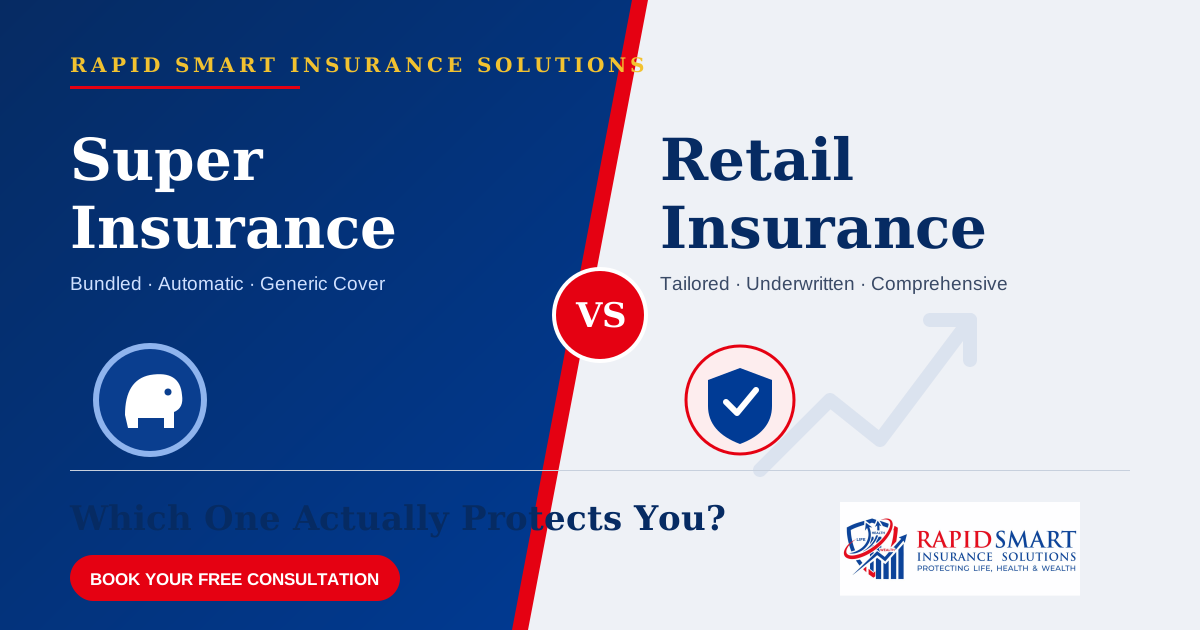
Super vs Retail Life Insurance: Side-by-Side Comparison
| Feature | Super Insurance | Retail Insurance |
|---|---|---|
| Cost source | Deducted from super balance | Paid from personal income |
| Underwriting | Often automatic acceptance | Full health underwriting at application |
| Cover amount | Default, generic | Tailored to your needs |
| Trauma cover | Rarely available | Widely available |
| TPD definition | Often "any occupation" (harder to claim) | Can select "own occupation" (easier to claim) |
| Portability | Tied to fund; may lapse if inactive | Stays with you for life, regardless of job changes |
| Impact on retirement savings | Reduces super balance over time | No impact on super |
| Claims process | Often longer, dual-trustee involvement | Usually more direct |
The Hidden Cost of "Free" Cover in Super
The biggest misconception we see at Rapid Smart Insurance Solutions is that super insurance is free. It isn't — it's simply invisible. Every premium paid from your super account is:
- Money that isn't invested and growing for your retirement, and
- Compounding lost growth over decades, which can add up to a significant retirement shortfall.
For a 30-year-old, even a modest annual premium taken from super can translate into tens of thousands of dollars in lost retirement savings by age 65, purely due to lost compound growth. That's a real trade-off worth understanding — not a reason to cancel cover outright, but a reason to check whether the cover you have is the right cover, at the right cost.
TPD Definitions: Why "Any Occupation" Can Be a Trap
This is one of the most important — and least understood — differences between super and retail cover.
- "Any occupation" TPD (common in super): you must be unable to work in any occupation you're reasonably suited to by education, training, or experience — not just your own job. This makes claiming significantly harder.
- "Own occupation" TPD (available through retail): you only need to be unable to perform the material duties of your specific job. This is a meaningfully lower bar to meet and is generally not available inside super.
If your job is physically demanding, highly specialised, or income-dependent on specific skills, this distinction alone can be the difference between a successful claim and a rejected one.
When Super Insurance Might Be the Right Fit
Retail isn't automatically "better" for everyone. Super-based cover can make sense if you:
- Are early in your career and need a low-cost way to get some protection in place
- Have cash flow constraints and can't stretch to out-of-pocket premiums right now
- Have straightforward needs and a modest level of debt or dependants
- Are in good health but want to avoid underwriting for a smaller amount of cover
When Retail Insurance Is Usually the Stronger Choice
Retail cover tends to make more sense if you:
- Have a mortgage, children, or a partner financially dependent on your income
- Want Trauma cover, which is rarely offered inside super
- Work in a role where an "own occupation" TPD definition genuinely matters
- Want certainty that your cover won't lapse due to account inactivity
- Want a policy that stays with you for life, independent of your employer or fund
It Doesn't Have to Be All or Nothing
A well-structured strategy often blends both: using super to fund a base level of Life and TPD cover (preserving personal cash flow), while topping up with a retail policy for Income Protection, Trauma cover, or a more suitable TPD definition. The right mix depends entirely on your income, debts, dependants, health, and stage of life — which is exactly why generic "default" cover rarely fits anyone perfectly.
Get a Clear, Personalised Comparison — At No Cost
Reading about the differences is a good start. But the only way to know whether your current super insurance is actually protecting you — or quietly underinsuring you while draining your retirement balance — is to have it properly reviewed against your real circumstances.
At Rapid Smart Insurance Solutions, we help everyday Australians cut through the fine print of PDS documents and group insurance terms, so you can see exactly what you're covered for, what you're not, and where the gaps are.
Book your free, no-obligation consultation today and let our team run a side-by-side comparison of your existing super cover against a tailored retail solution — so you can make the decision with full information, not assumptions.
👉 Book Your Free Consultation with Rapid Smart Insurance Solutions
This article is general information only and does not take into account your personal objectives, financial situation, or needs. Please consider seeking personal financial advice before making any decisions about your insurance or superannuation.